
GLPI Presence
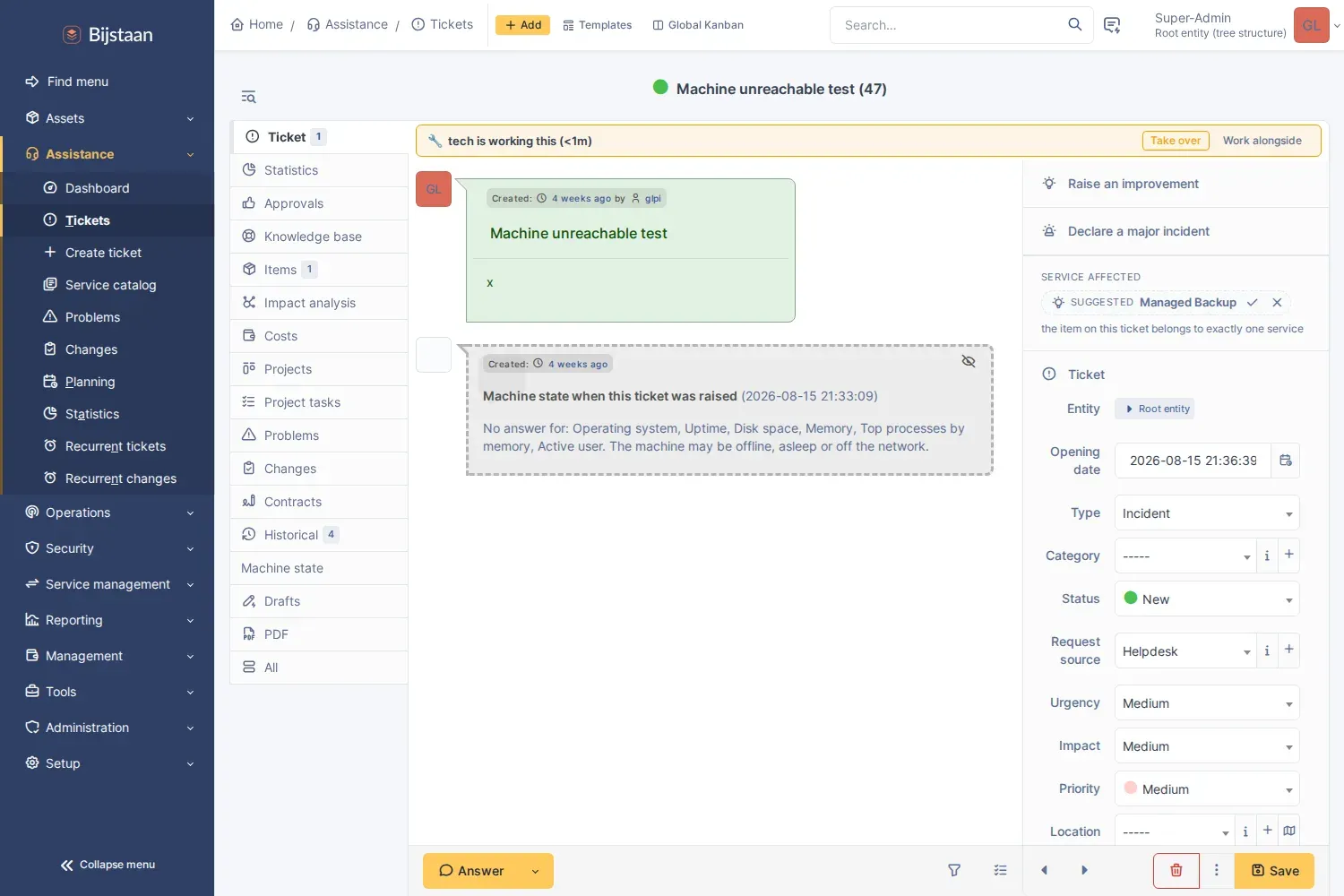
Collision detection and live presence for technicians on GLPI ITIL objects. Who else has this ticket open, who is typing right now, and who has picked the work up.
Compared to core’s ObjectLock
Section titled “Compared to core’s ObjectLock”ObjectLock (core) |
This plugin | |
|---|---|---|
| Model | Pessimistic, exclusive | Advisory, informational |
| Holders | Exactly one (UNIQUE (itemtype, items_id)) |
Any number of participants |
| Effect on others | Forced into a read-only profile | None; never blocks |
| Granularity | Locked / not locked | Viewing vs typing vs claimed |
| Recovery | Cron sweep measured in hours | Seconds (TTL), plus explicit leave |
| Default | Off, opt-in per itemtype | On for Ticket/Change/Problem |
The two coexist. Core locking enforces; this one informs.
Features
Section titled “Features”- Presence — who else has the item open, one entry per person. Two tabs show once.
- Typing — who is composing a reply, task or solution, with a pulsing indicator that decays on its own, so a crashed browser leaves no ghost.
- Soft claim — a voluntary “I’m working this”. Others see the holder and are offered Take over or Work alongside. Nobody is blocked. Claims expire on inactivity rather than disconnect.
who_is_on_itread-only tool forglpiai: viewers, typists and the claim holder. Claiming is not offered as a tool — a claim asserts that a named person is doing the work.
Technician (central) interface only. Requesters never see presence and their own presence is never reported.
Install
Section titled “Install”# from the GLPI rootgit clone https://github.com/bijstaan/glpi-presence.git plugins/glpipresencephp bin/console plugin:install -u glpi glpipresencephp bin/console plugin:activate glpipresenceSettings
Section titled “Settings”Setup → Plugins → GLPI Presence.
| Setting | Default | Notes |
|---|---|---|
| Itemtypes | Ticket, Change, Problem | Where the bar appears |
| Heartbeat (focused) | 8s | Must stay under the typing TTL |
| Heartbeat (background) | 45s | Backgrounded tabs cost far less |
| Presence TTL | 90s | When a silent technician is treated as gone |
| Typing TTL | 12s | How fast “is typing” fades |
| Claim enabled | yes | Off for presence only |
| Claim idle TTL | 30m | Inactivity before a claim is released |
Contradictory values are reconciled rather than rejected: a bad number degrades to the nearest workable one instead of taking presence down.
The focused heartbeat must be shorter than the typing TTL. Presence is a
sampling system — poll every 15s with a 12s typing TTL and a colleague can type
a whole sentence between two polls unobserved. Settings::reconcile() enforces
this by raising the typing TTL if the heartbeat is slow; a fast heartbeat is the
better fix.
Polls go hot (4s) for 20s whenever someone else is typing.
How it works
Section titled “How it works”GLPI 11 has no WebSocket or SSE channel, and a long-lived PHP request per open ticket would pin an FPM worker each, so this polls.
browser (public/js/presence.js) │ POST ajax/presence.php {heartbeat|leave|claim|takeover|release} ▼Presence ── glpi_plugin_glpipresence_presence (one row per browser tab)Claim ── glpi_plugin_glpipresence_claims (one row per item) ▲GarbageCollector (cron, 5m) + sampled sweep on ~1 in 20 heartbeats- Times are stored as unix integers, not SQL
TIMESTAMP. Expiry is computed in PHP, and mixing PHP’s clock with MySQL’sCURRENT_TIMESTAMPmakes presence wrong whenever the two disagree on timezone. - Departure is reported with a
keepalivefetch onpagehide, so closing a tab removes you immediately.sendBeaconis a fallback only: it cannot set headers, and headers are what keep the CSRF token on the preserving path. - CSRF. GLPI 11 validates in the kernel and treats transports differently —
an XHR header token (
X-Glpi-Csrf-Token) is preserved, a POST body token is consumed. A heartbeat every 8s consuming tokens would empty the session pool within minutes and break unrelated forms in other tabs. The client always sends the header form, and the endpoint does not re-check, since a second check would reject every request whose token the kernel just consumed.
The same three actions over the high-level API, for glpimobile. Every route
re-authorises against the addressed item: reading takes read access, claiming
takes write access. Central interface only.
| Method | Path | Purpose |
|---|---|---|
GET |
/GlpiPresence/item/{itemtype}/{items_id} |
who is here, and who holds the claim |
POST |
/GlpiPresence/item/{itemtype}/{items_id}/heartbeat |
“I am here”, optionally “I am typing” |
POST |
/GlpiPresence/item/{itemtype}/{items_id}/leave |
stop being here |
POST |
/GlpiPresence/item/{itemtype}/{items_id}/claim |
claim the work (409 when held) |
POST |
/GlpiPresence/item/{itemtype}/{items_id}/takeover |
take an existing claim |
POST |
/GlpiPresence/item/{itemtype}/{items_id}/release |
hand it back |
Every route answers with the same state object — server_time, you,
can_claim, presence_ttl, participants, claim — so a client that lost a
race re-renders from the truth. server_time is included because “claimed 40
minutes ago” is computed from this server’s timestamps and a phone’s clock may
be an hour out.
The app beats more slowly than the browser by design: a phone screen is off most
of the time and radio wake-ups cost battery. Presence expires on presence_ttl
regardless, so a slow client appears and disappears more coarsely.
Feature discovery goes through glpimobile’s glpimobile_capabilities hook:
presence (a central-interface session) and claim (soft claims on).
cd tests/browser && node presence-check.jsDrives two real technicians through the whole lifecycle: both arriving, typing, claiming, taking over and leaving.
Limitations
Section titled “Limitations”- Taking a claim is silent; the previous holder finds out by looking.
- Claims are not written to the item’s Historical tab.
Licence
Section titled “Licence”GPL-3.0-or-later, the same licence as GLPI. The plugin is loaded into GLPI’s process and extends its classes, so it is a derivative work. See LICENSE.