
GLPI KEDB
A known-error database that surfaces workarounds mid-ticket, and turns recurring incidents into problem candidates a human decides on.
Compared to KnowbaseItem and Problem
Section titled “Compared to KnowbaseItem and Problem”| KnowbaseItem | Problem | KnownError | |
|---|---|---|---|
| Nature | Reference material | The investigation | The operational answer while a fix is pending |
| Lifecycle | None | Open → resolved | known → workaround available → fix in progress → resolved/retired |
| Retiring | N/A | Closing the Problem | Explicit; stops surfacing, keeps its history |
| Reaches a ticket | Only if someone goes looking | Manual link | Automatically, matched by category/CI/symptom |
| Points back at incidents | No | Is the record of one | Nightly, from ticket clusters |
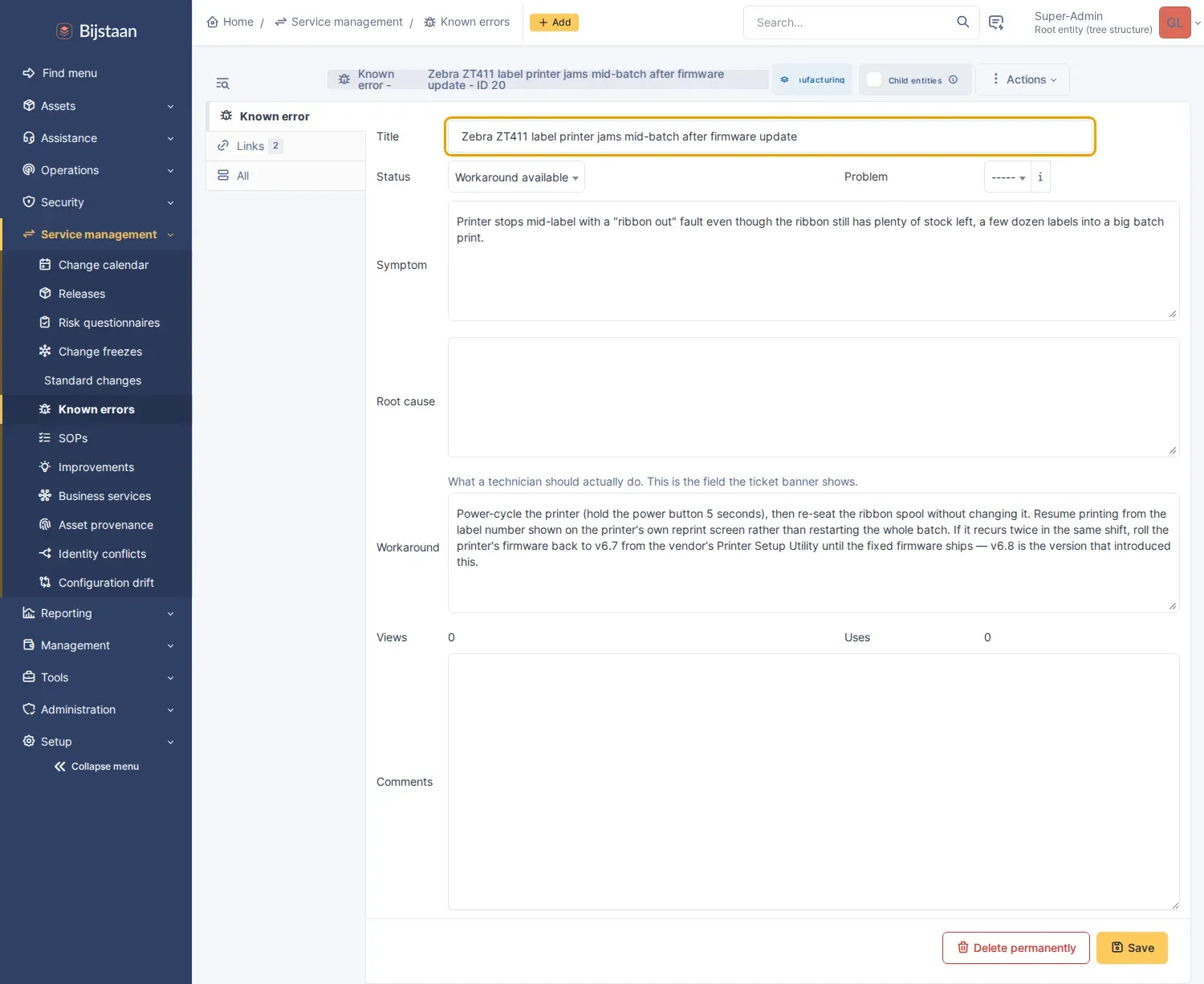
The workaround field is the primary operational element; the remaining fields provide context and linkage.
Features
Section titled “Features”-
KnownError itemtype — title, symptom, root cause, workaround (all rich text), status, one optional linked Problem, links to N ITIL categories, N configuration items and N free-text software names, entity scope, view and use counters.
-
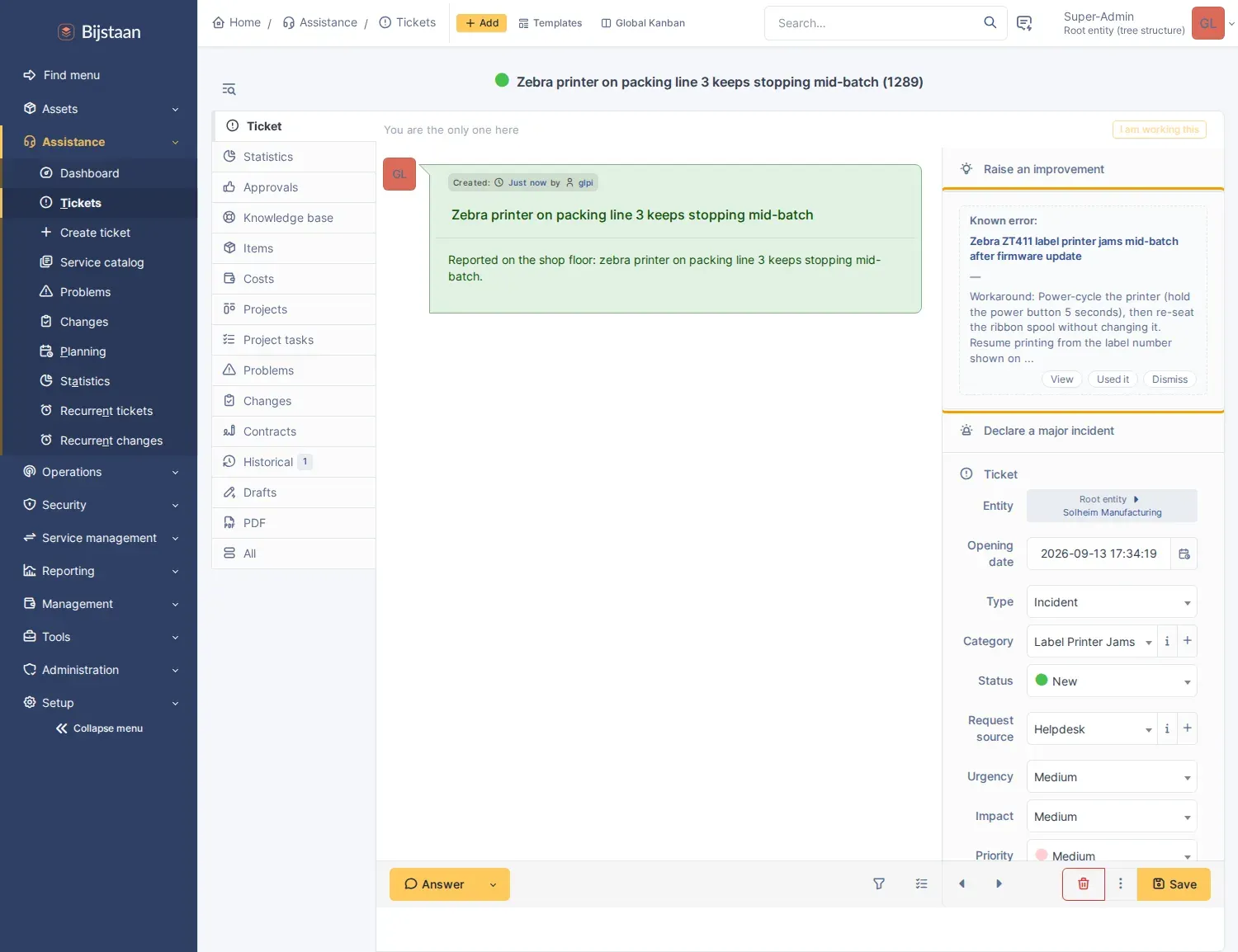
Ticket banner, central interface only. Matches by ITIL category (walking parent categories), by linked configuration item, and by symptom keyword. Keyword matching is typo-tolerant through
glpisearchwhen that is installed and indexing KnownError, and aLIKEsearch otherwise. -
Hit log — every shown/used/dismissed event as its own row, per KE and ticket, which is where the stats page comes from. A dismissal is scoped to the ticket rather than the technician. “Used it” puts an editable followup snippet in whatever editor is open; it never posts.
-
Deterministic candidate clusterer, always on and with no dependency on any other plugin: same entity + same category, or same entity + same CI, ≥K tickets in the trailing M days, none linked to a Problem yet.
-
AI candidate clusterer, gated on
glpiaibeing active, the entity’s own allowlist, and a switch of this plugin’s own. Additive to the deterministic pass, never a replacement. -
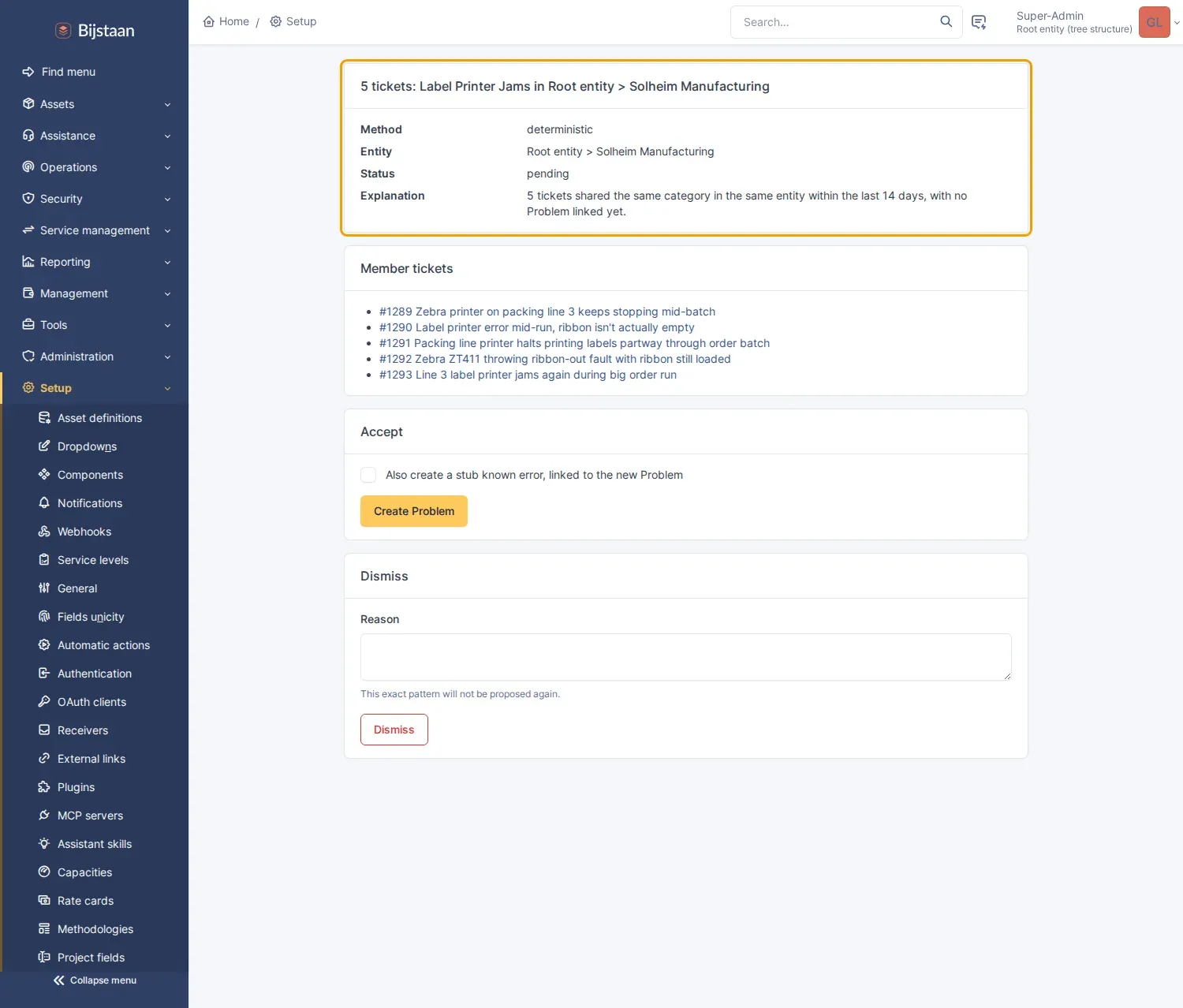
Review queue — accept (creates a core
Problem, links the member tickets, optionally a stub KnownError) or dismiss with a reason. A dismissed fingerprint is never proposed again.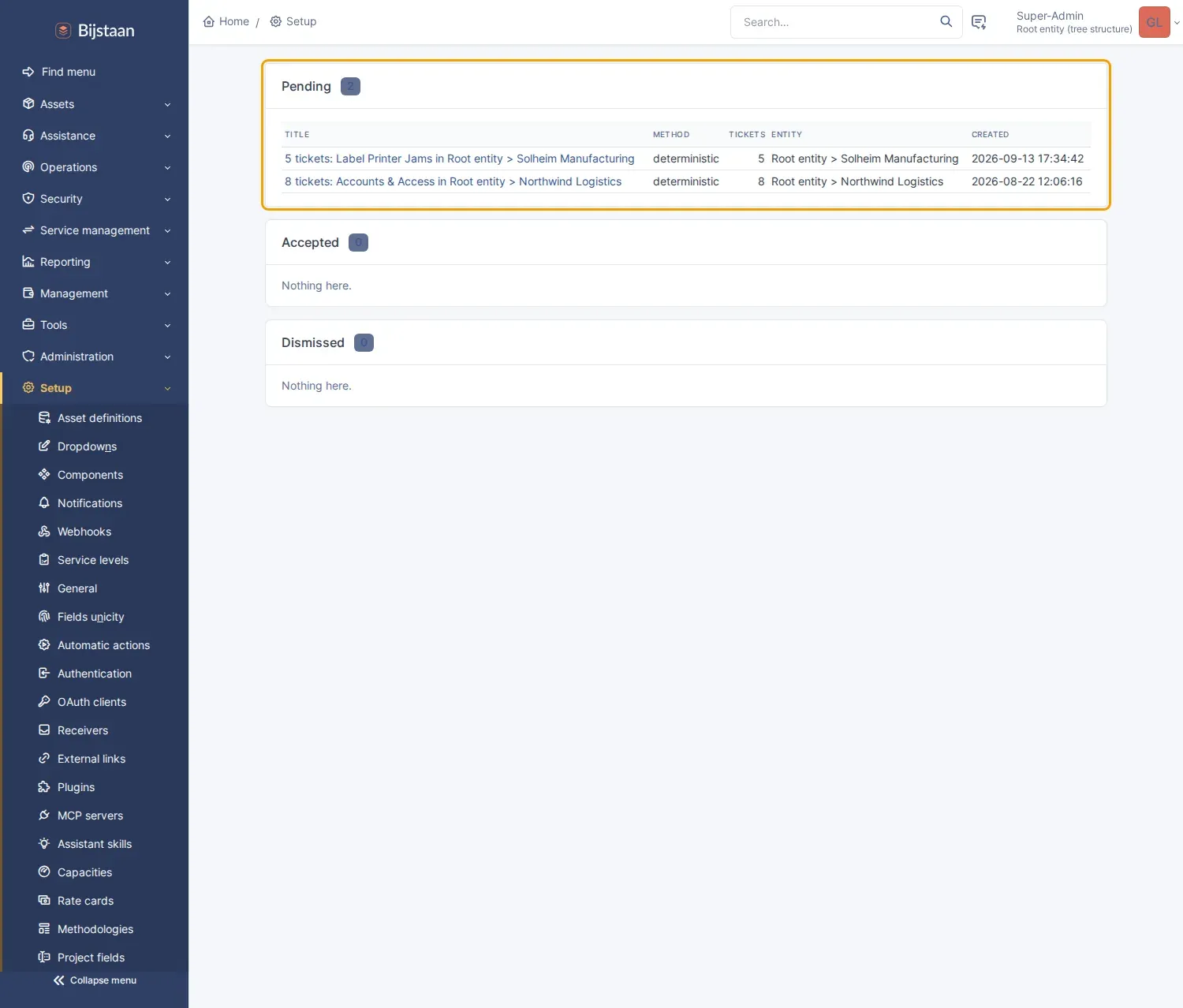
-
5 whys tab on core’s
Problem— five ordered why/answer pairs, contributing factors, a countermeasure. Locks when marked complete; unlocking is a click rather than a permission, and is logged.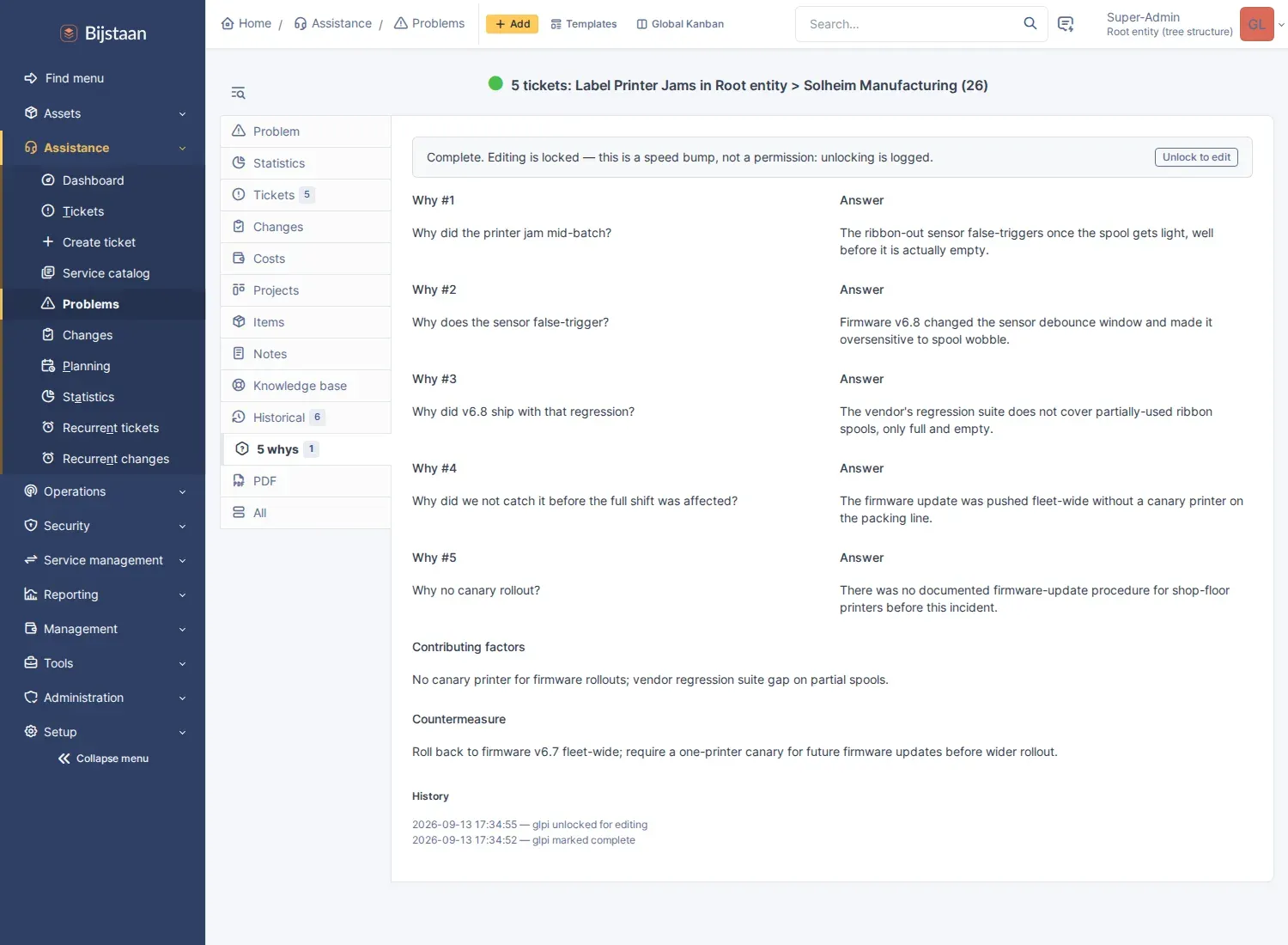
-
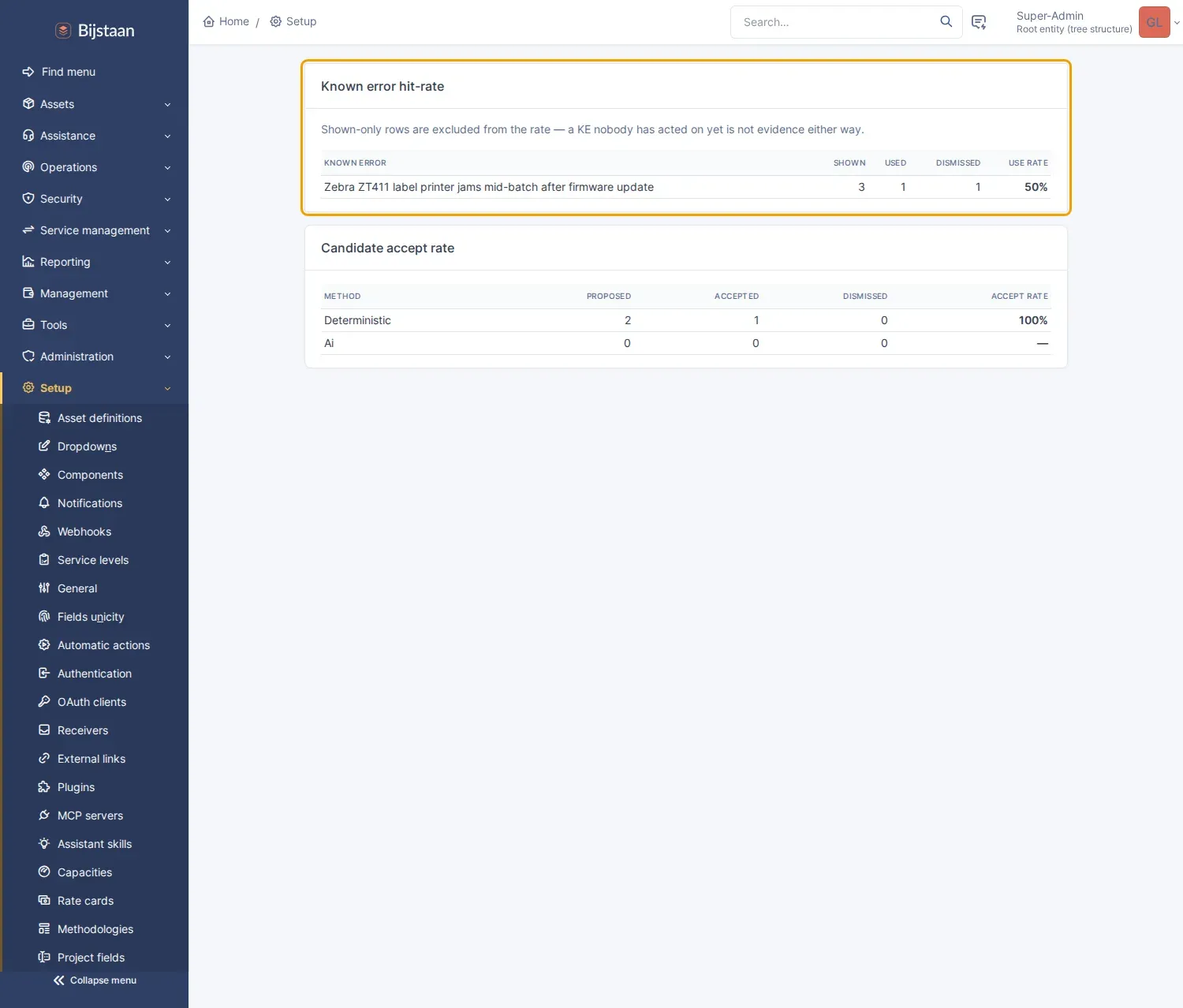
Stats — KE hit rate (shown/used/dismissed, use rate excluding undecided rows) and candidate accept rate by method.
Install
Section titled “Install”# from the GLPI root — the directory must be named for the plugin key,# which is not the repository namegit clone https://github.com/bijstaan/glpi-kedb.git plugins/glpikedbphp bin/console plugin:install -u glpi glpikedbphp bin/console plugin:activate glpikedbSettings
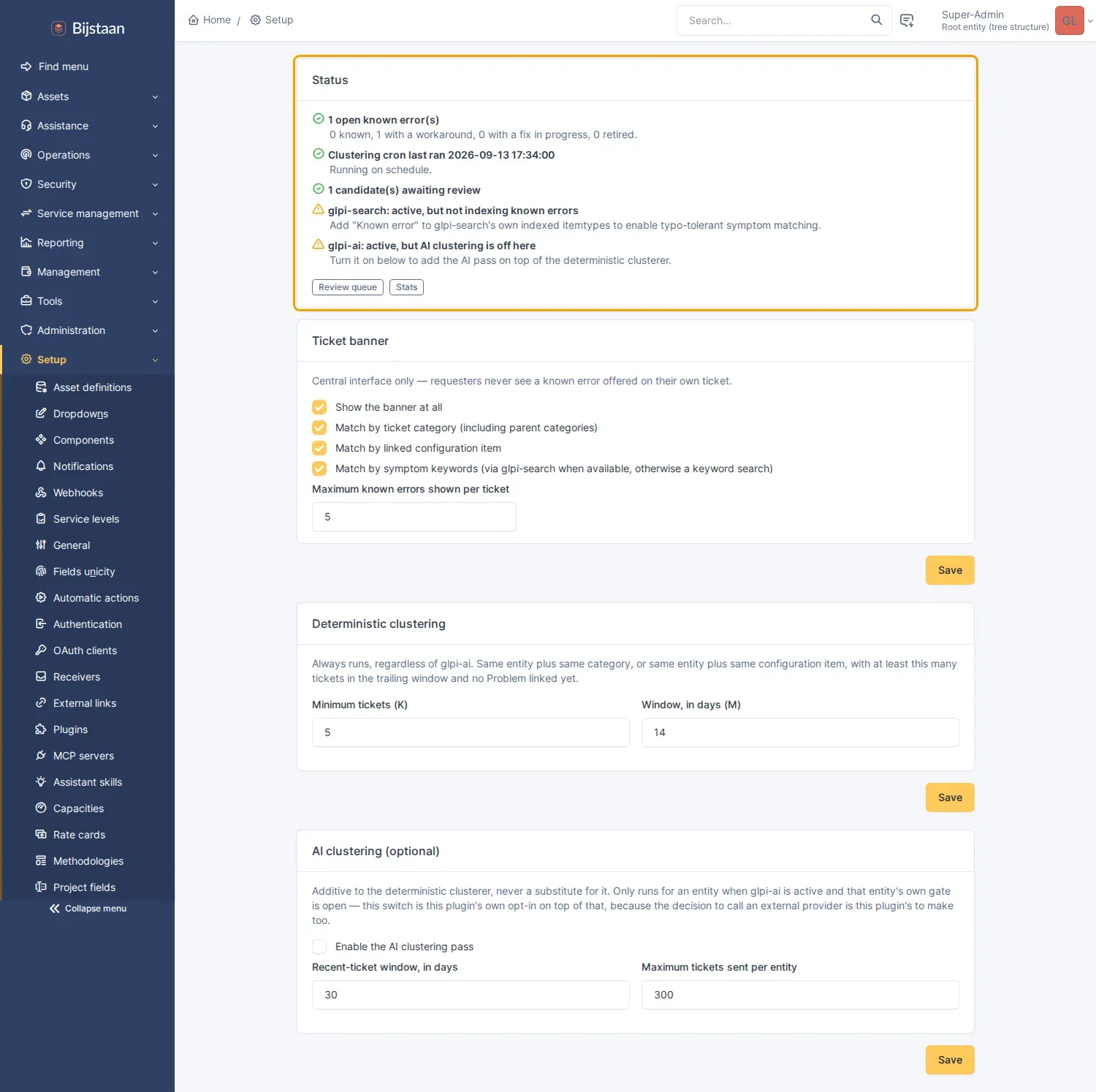
Section titled “Settings”Setup → Plugins → GLPI KEDB. Opens on a status card: KE counts, cron freshness, whether glpisearch is indexing known errors, whether glpiai is active and how many entities pass its gate.
| Setting | Default | Notes |
|---|---|---|
| Show the banner at all | on | |
| Match by category | on | Walks parent categories too |
| Match by linked CI | on | |
| Match by symptom keywords | on | glpisearch when it is indexing KnownError, LIKE otherwise |
| Max known errors per banner | 5 | |
| Cluster minimum tickets (K) | 5 | |
| Cluster window in days (M) | 14 | |
| AI clustering | off | Requires glpiai active, the entity’s gate open, and this switch |
| AI recent-ticket window | 30 days | |
| AI max tickets per entity | 300 | Cost control |
Rights
Section titled “Rights”plugin_glpikedb_ke— read/create/update/delete/purge, separately grantable at read and update. Authoring known errors.plugin_glpikedb_queue— read/update. Triaging the candidate queue.- The 5-whys tab uses core’s
problemright; it is content of the Problem record, not a domain of its own.
Limitations
Section titled “Limitations”- The keyword fallback is blunt. Without glpisearch indexing
KnownError, symptom matching is a token overlap count againstLIKE '%word%'— no typo tolerance, no semantics. It will miss a ticket phrased very differently from the KE. The status card says which mode is active. - Category and CI matching read the ticket as it currently is. A ticket recategorised after the banner rendered will not re-match until reload.
- AI cluster fingerprints have no growth immunity. The deterministic fingerprint is built from axis criteria, so a dismissed cluster that gains a ticket is not re-proposed. An AI cluster has only the ticket set the model named, so a near-identical later set is a new candidate.
- “Used it” cannot always find an editor. GLPI’s timeline shares one
content-named field across the followup, task and solution editors with no stable id. With none open, the workaround text goes to the clipboard with a prompt rather than nowhere. - The deterministic clusterer reads recent tickets per entity in full on every cron run, with no incremental state. An instance with very high per-entity ticket volume would want that made incremental first.
tests/matcher.php and tests/clusterer.php are pure PHP — no DB, no GLPI
bootstrap:
php tests/matcher.phpphp tests/clusterer.phptests/integration.php needs a live GLPI with the plugin active and creates and
cleans up its own fixtures; see tests/run.sh. tests/browser/kedb-check.js
drives the full scenario in a browser — banner, View/Used it/Dismiss, the
nightly cron turning five similar tickets into a queue candidate, accept →
Problem, and the 5-whys lock/unlock/audit round trip — and takes the screenshots
above.
Licence
Section titled “Licence”GPL-3.0-or-later, the same licence as GLPI. The plugin is loaded into GLPI’s process and extends its classes, so it is a derivative work. See LICENSE.