
GLPI AI
A vendor-neutral model layer for GLPI 11, along with the AI capabilities built on top of it.
The foundational layer provides a normalized request vocabulary, four provider adapters, a tool-calling registry that other plugins can extend, a per-entity gate governing outbound data, and logging of requests, responses, and tool executions.
Technician-facing features include triage suggestions, solution and article drafting, reply review, and HEIMDALL, a troubleshooting assistant that queries connected tools.
Depends on nothing outside GLPI’s own vendor tree.
Features
Section titled “Features”-
One API for four vendors — Anthropic, OpenAI, Google Gemini and Azure AI Foundry, each reachable at a custom endpoint. Callers build a
Promptand get aCompletion; the differences live in the adapters. -
Credentials encrypted at rest by GLPI with GLPI’s key, so
glpi:security:changekeyrotates them and the change history masks them. -
A tenant gate. Which entities may have their data sent to a provider is configuration, and the default permits nothing.
-
Tool calling on all four vendors: 29 native tools over GLPI’s own data, 22 reads and 7 writes.
- Reads cover the record (a ticket, problem or change and what was said on it), the promise (which SLA and OLA apply, working time left, what has breached), the entity (who they are, what is agreed, which contracts cover what, how much they raise), the estate (assets, installed software and licence position, warranties, consumable stock) and the people (who is in a group, whose diary is full, who was asked to approve something, whether the requester was actually emailed).
- Writes are an internal note on a ticket, problem or change; a task; the ticket’s filing; a link between tickets; a machine attached to a ticket; and an unpublished knowledge article. They are off until an administrator turns them on, none is requester-facing, and none deletes anything.
- Around them is a registry 18 other plugins add to — some sixty more tools, from backup state and on-call rotas to cloud drift, vulnerability exposure and post-incident actions.
- Past eight registered tools the model searches for them rather than being handed all of them, which keeps a hundred-tool instance sending about thirty schemas on a request.
-
An MCP client for external servers, including OAuth 2.1 discovered from the server’s own URL with client-credentials or authorization-code grants, authenticating either as the instance or as each technician’s own account — which they connect from My settings → AI connections.
-
Triage suggestions on tickets that arrived as prose: a proposed category, urgency, impact and procedure, as chips above the ticket fields. Nothing is applied without a click, and every accept and dismiss is recorded, which is what turns “the AI seems decent” into a number per field.
-
Solution and article drafting from the evidence on a worked ticket — the followups, the tasks, the checks a procedure recorded. The solution is offered inside GLPI’s own editor and inserted only on a click; the article is created unpublished.
-
HEIMDALL — Helpdesk Endpoint Inspection, Monitoring, Diagnostics And Live Lookup — a troubleshooting agent in a panel over any page. It knows what the technician has open and can reach every registered tool, including
glpiosquery’s live queries andglpinetscan’s SNMP findings, and reaches exactly what that technician could have found by hand.The run narrates itself: each tool as it is called with its arguments, what came back, the model’s reasoning where the provider sends it, and the answer a word at a time, with a switch between keeping every step on screen and keeping only the one running. An answer that hits the output ceiling is carried on rather than cut off. Past conversations are listed and resume in place.
-
Reply review — the one place a model here touches requester-facing text, and it does so by reading. A technician can ask for a second read before sending: internal content carried across, an unexplained term, no statement of what happens next, the wrong tone. Remarks, never a rewrite; Save is never blocked. Off by default, since to spot a leak it has to see the internal notes.
-
A usage log — provider, model, tier, token counts, duration and a prompt fingerprint, per entity and per user — plus a separate audit trail of every tool call.
- It does not talk to a requester. Every feature is technician-facing. The one requester-adjacent case is a model reviewing a reply a human wrote, which returns remarks rather than text.
- It does not fall back between vendors. One provider is active at a time. A fallback chain sounds like resilience and means a request can land at a vendor the entity policy was never written for.
- It does nothing on install. Master switch off, no provider selected, empty allowlist.
Setting it up
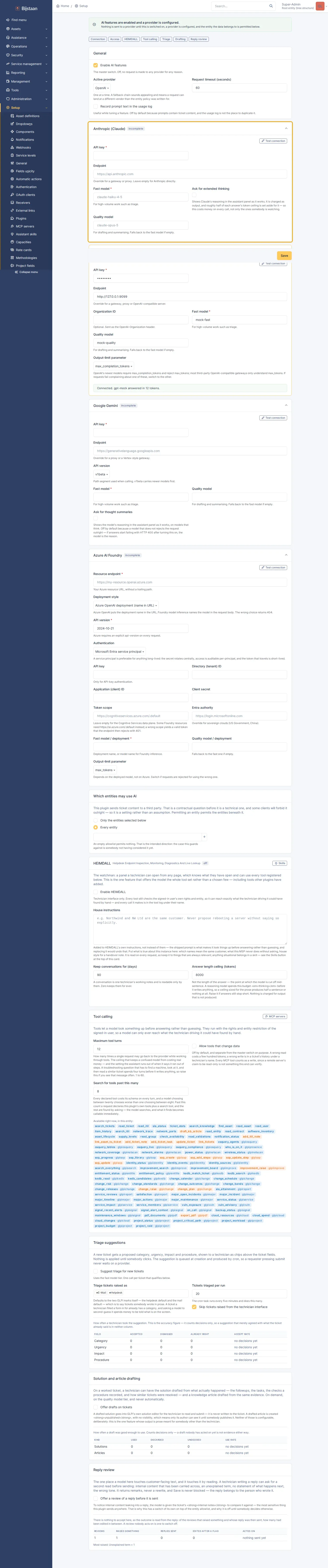
Section titled “Setting it up”Setup → AI.
- Fill in a provider’s card — API key, model names, and an endpoint if you are going through a gateway. Save.
- Press Test connection. Having the fields filled in is a different claim from the credentials being valid, the deployment existing, and the endpoint being reachable through whatever proxy sits in the way.
- Choose the active provider and switch Enable AI features on.
- Decide which entities are permitted.
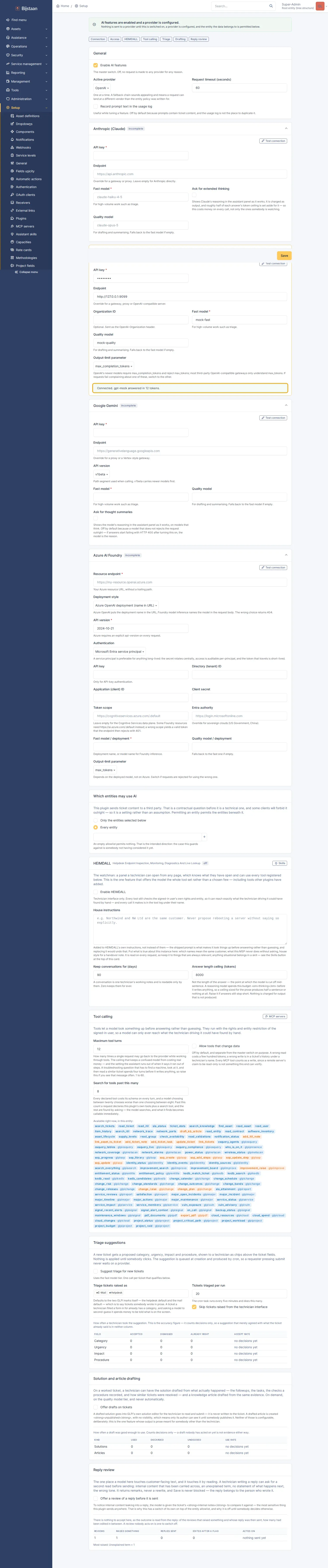
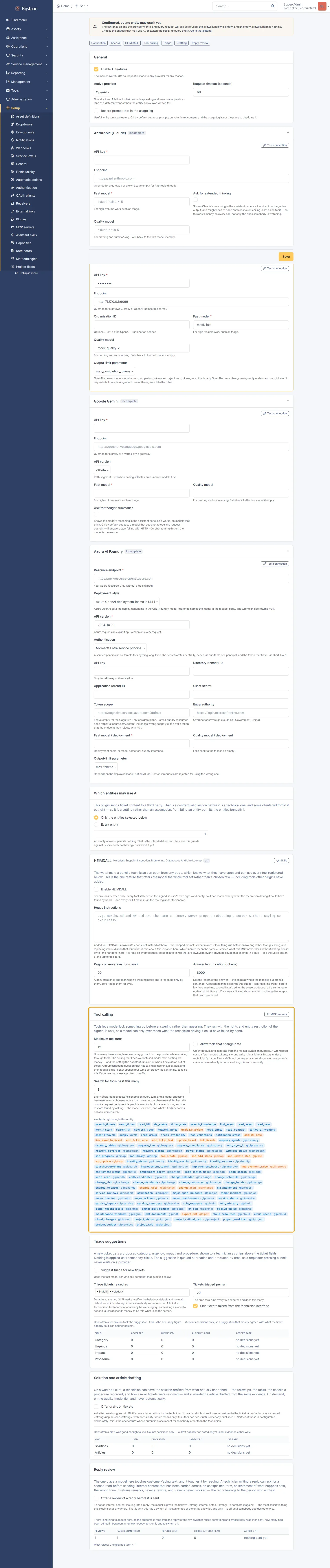
Tools run with the rights and entity restriction of the signed-in user, so a model can only reach what the technician driving it could reach by hand. Tools that change data are off by default and switched on separately from the master switch. External MCP servers are connected under Setup → AI → MCP servers.
The entity gate
Section titled “The entity gate”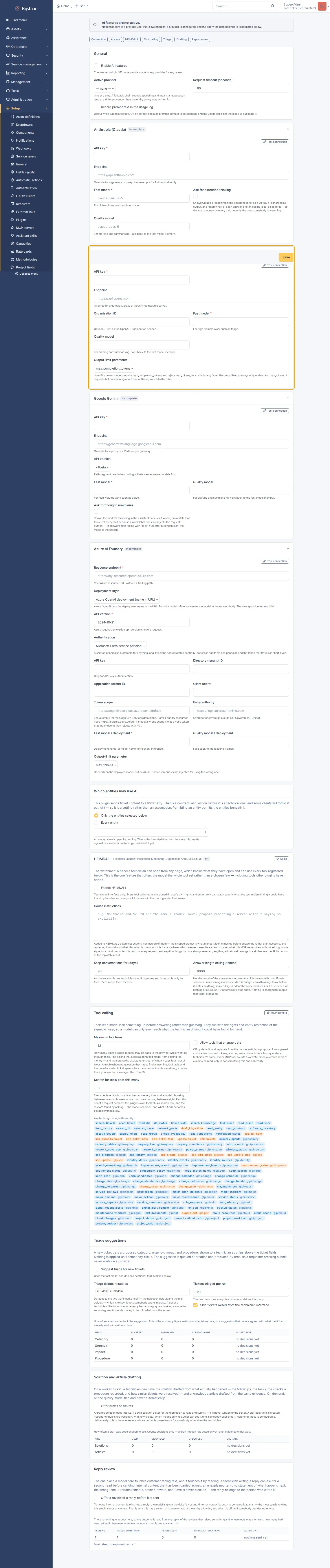
This plugin sends ticket content to a third party. That is a policy question before a technical one, and some organisations forbid it outright, so it is configuration rather than an assumption.
Permitting an entity permits those beneath it, which is how you would model an organisation with a sub-entity per site. An empty allowlist permits nothing, including the root entity: the failure this guards against is precisely somebody not having considered the question yet.
The entity is a required argument to Client::complete() rather than something
read from the session, because background work — cron, the mail collector, a
queue worker — has no session, and a gate that quietly resolved to entity 0 there
would be no gate at all.
Calling it from another plugin
Section titled “Calling it from another plugin”use GlpiPlugin\Glpiai\Client;use GlpiPlugin\Glpiai\Prompt;
$prompt = Prompt::make( "Ticket: {$ticket->fields['name']}\n\n{$ticket->fields['content']}", 'You are triaging helpdesk tickets. Answer only with the schema.')->withTier(Prompt::TIER_FAST)->withSchema([ 'type' => 'object', 'properties' => [ 'category' => ['type' => 'string'], 'urgency' => ['type' => 'integer'], ],], 'triage');
try { $completion = Client::complete($prompt, (int) $ticket->fields['entities_id']); $suggestion = $completion->data; // decoded, schema-shaped} catch (AiException $e) { // $e->kind is one of: disabled, auth, rate_limit, server, invalid_request, // refused, transport. $e->isRetryable() and $e->userMessage() are for // deciding what to do and what to show.}For a request where the model may call tools, Client::run() is the equivalent
door: a loop over complete(), so the same guards hold on every turn rather than
only the first, returning a Conversation carrying every turn, every tool call
and the summed cost.
Client::complete() is the only door. It is where the master switch, the entity
gate, the timeout ceiling and the usage record are enforced, once. A caller
reaching past it into Registry would silently opt out of the entity policy, and
nobody would notice until somebody asked.
The two model tiers
Section titled “The two model tiers”Every provider is configured with a fast model and a quality one, and callers say which shape of work they are doing rather than naming a model. Triage is high-volume and low-value-per-call; drafting a resolution is the opposite. Pinning both to one model means overpaying for one of them, and which model each maps to is the administrator’s decision.
Portable schemas
Section titled “Portable schemas”All four vendors support constrained JSON output, through four request shapes and
three schema dialects — OpenAI demands additionalProperties: false and every
key in required; Gemini rejects additionalProperties outright and wants types
upper-cased. The adapters translate what is translatable, so keep schemas to
plain types, plain nesting and enum. Anything exotic will survive on some
providers and be rejected by others.
Prompt::$extra is the escape hatch for vendor-specific parameters, and is
an ugly one: anything put there is not portable.
The four features are reachable from glpimobile over the high-level API, with
the rights of the ajax/ endpoint each stands in for — thread ownership through
Thread::mine(), drafting through Drafter::refusal(), triage and drafting
through Ticket::canUpdateItem() — and central-interface only.
| Method | Path | Purpose |
|---|---|---|
GET |
/GlpiAi/status |
what will actually answer, in the entity of the request |
GET |
/GlpiAi/threads |
the caller’s recent conversations |
POST |
/GlpiAi/threads |
open or resume the thread for a context |
GET |
/GlpiAi/threads/{id} |
one conversation with its transcript |
POST |
/GlpiAi/threads/{id}/ask |
ask, and wait for the finished answer |
POST |
/GlpiAi/threads/{id}/stream |
ask, and receive the run as server-sent events |
DELETE |
/GlpiAi/threads/{id} |
clear a transcript |
GET/POST |
/GlpiAi/tickets/{id}/draft |
the drafted solution, and asking for one |
POST |
/GlpiAi/drafts/{id}/used · /discard |
what became of a draft |
GET/POST |
/GlpiAi/tickets/{id}/triage |
the triage suggestion, and running it now |
POST |
/GlpiAi/triage/{id}/apply · /dismiss |
accept or reject one proposed field |
POST |
/GlpiAi/reply/review |
read a drafted reply before it is sent |
Streaming, because a still spinner reads as a crash. An agent run is four to
eight vendor round trips and takes the better part of a minute; on a phone that
is long enough for somebody to background the app, which kills the request.
/threads/{id}/stream speaks the same events as ajax/assistant-stream.php —
turn, tool, tool_result, thinking, text, continued, done, failed,
plus an open frame — through the same Progress sink, so there is one
narration and not two. It is a Symfony StreamedResponse wrapped in the HL API’s
StreamedResponseWrapper, which keeps the router from sending headers and
stringifying a body that does not exist yet.
/status exists because the capability map cannot answer for it: that map is
computed once per session, the entity gate is not a session property (the
technician can switch entity in the app), and “may this entity’s data reach a
provider” is decided per entity.
Feature discovery goes through glpimobile_capabilities
(plugin_glpiai_mobile_capabilities() in setup.php): assistant, draft,
reply_review, triage, all false outside the central interface.
Install
Section titled “Install”# from the GLPI root — the directory must be named for the plugin key,# which is not the repository namegit clone https://github.com/bijstaan/glpi-ai.git plugins/glpiaiphp bin/console plugin:install -u glpi glpiaiphp bin/console plugin:activate glpiaiNine PHP suites and five browser suites, none needing a real credential or any network egress.
docker compose -p glpi exec glpi sh -c 'cd /var/www/glpi/plugins/glpiai && tests/run.sh'
cd tests/browser && ./ai-setup.sh start && node ai-check.jsnode triage-check.js && node drafts-check.jsnode assistant-check.js./ai-setup.sh stoptests/adapters.php— the one that matters most. Translation is the only thing this code is responsible for, and every mistake in it produces a request that looks plausible and is accepted by nobody. It drives all four adapters from one identicalPromptagainst a mock vendor API and asserts on what each sent.tests/tools-wire.php— the same discipline for tool calling: three shapes per vendor, and getting one subtly wrong produces a model that stops calling tools.tests/integration.php— settings persistence, encryption at rest, the tenant gate against a real entity tree, and the guards onClient::complete(). It restores the configuration and purges the entities it creates.tests/tools.php— rights, entity scoping, the write switch, the agent loop, the audit trail, and the MCP client against a mock server.tests/triage.php— eligibility, the taxonomy as an allowlist, a hallucinated category being discarded, and the accept-rate arithmetic. Several assertions check only that the ticket is unchanged.tests/drafts.php— the evidence gatherer, both schemas, and the outcomes. Several assertions check what did not happen: no solution written to the ticket, and a created article with no visibility rows at all.tests/discovery.php— that every tool can be found. Almost everything past the pinned handful is reached throughfind_tools, whose ranker is word overlap with no synonyms and the crudest stemming, so a tool whose description lacks the words people use is a tool nobody will call. It asks the question a technician would ask and asserts the right tool comes back.tests/native-tools.php— the deeper reads and the writes, driven throughToolRegistry::execute()rather than by calling handlers, because for a write tool most of the interesting behaviour is on the path a model takes: the write switch, the profile right, the missing-argument check. Its sharpest assertions are negative — a note cannot be made public even whenis_privateis passed, astatusargument is ignored, a link needs rights at both ends.tests/reply.php— where the strip draws and where it must not, the flags that survive validation, and the outcome. The mock answers a review by comparing the ticket’s internal notes with the reply, so “the internal notes reached the prompt” is a checked fact.tests/streaming.php— the three adapters that stream, and the event channel. The mock chops text mid-word and splits every tool call’s JSON arguments across frames on purpose: an adapter that buffered the stream and called back once would produce an identicalCompletionand show a technician nothing until the end, so assertions are on the number of fragments as much as the content. It also holds the rule that thinking never becomes the answer.tests/mcp-user-auth.php— MCP servers authenticating the person rather than the instance. Mostly about what one person’s credential does not do: another technician’s lookup finds nothing and their call is refused; a run with no signed-in person is refused rather than falling back to whichever grant exists; the in-flight authorization lives on the person’s own row so two people can connect at once; nothing personal is written to the server record.tests/oauth-toolbox.php— the OAuth grants against a mock authorization server that checks the client secret, the PKCE verifier and whether a code has been used; plus the tool-search threshold, ranking, and the wire that makes a found tool callable on the next turn.tests/assistant.php— the conversation and the tools. The network tools are driven against a real switch, laptop and cable so “follows a cable” is a checked fact, and the live-query guards are asserted directly rather than through a model, because a guard that only holds when a model behaves is not a guard.tests/browser/ai-check.js— the settings page, including the two things only a browser reaches: the connection test’s CSRF handling, and that saving does not wipe credentials it is not showing you.tests/browser/drafts-check.js— the drafts tab and the strip inside GLPI’s solution editor. Its central assertion is that after clicking Insert the editor holds the draft and the ticket still has no solution.tests/browser/assistant-check.js— the panel: that it knows which record is open, that a different record gets its own conversation, that coming back resumes the first, that past conversations reopen from a page they were not had on, and that a requester never sees the launcher.tests/browser/triage-check.js— the panel, the chips and who can see them. It signs in as an ordinary Technician, because the people this feature is for are exactly the people who do not hold the configuration right, and as a self-service user, because they must never see it.
tests/mock-provider.php stands in for all four vendors plus Microsoft Entra,
and tests/mock-mcp.php for an MCP server, which also plays its own
authorization server. Both answer in the real shapes including the unhappy ones
that arrive as a successful HTTP response — a refusal, a safety block, a content
filter, a tool reporting its own failure — since those are easiest to mistake for
a working call that returned nothing.
For triage the mock parses the category list back out of whichever field that vendor puts the system instruction in, and answers by word overlap with the ticket. A canned response would sail through an assembly failure — a taxonomy that never reached the prompt, a ticket that never reached the user turn — because both produce a well-formed request.
Against a real model
Section titled “Against a real model”tests/live-ollama.php runs triage, drafting and the assistant against a live
Ollama host. Opt-in and not in run.sh, because a suite needing a GPU on the
network gets skipped — but a mock can only prove the plugin sent what it meant
to, and the claim here is about what a model does.
docker compose -p glpi exec glpi sh -c \ 'cd /var/www/glpi/plugins/glpiai && OLLAMA=http://host:11434 \ CHAT=some-model php tests/live-ollama.php'It found three things a mock structurally could not: a base URL ending in /v1
produced /v1/v1/chat/completions and a bare 404; a reasoning model spends its
whole output budget thinking and returns an empty message; and a small model
carries a department name into a knowledge article unless the instruction says,
in those words, to take team names out.
Layout
Section titled “Layout”setup.php hooks, and the SECURED_CONFIGS declaration that makes GLPI encrypt the credentialshook.php install/uninstall: the tables, one rightsrc/Prompt.php the neutral request — the intersection of what all four vendors can do, not the unionsrc/Client.php the one door: master switch, entity gate, timeout, loggingsrc/Settings.php configuration, including the secret round-tripsrc/UsageLog.php what every call cost and which model answeredsrc/ToolLog.php what the model went looking for, and on whose behalfsrc/Tool*.php the tool vocabulary and the registry that assembles itsrc/Conversation.php the record of one agent runsrc/Provider/ Registry, the Provider contract, Field, and the four adapterssrc/Tools/ the native tools and the rights-respecting search behind themsrc/Mcp/ the MCP client, the configured-server item, the OAuth 2.1 flows, the per-technician credentials, and the catalogue that turns a server into toolssrc/Toolbox.php tool searchsrc/Triage/ the taxonomy, the stored suggestion and its outcome, the service, and the panelsrc/Draft/ what happened on a ticket, the two drafts made from it, the tab, and the strip inside GLPI's solution editorsrc/Assistant/ the conversation, its starting context, and the agent loopsrc/Progress.php what the run is doing, for whoever is watchingsrc/MobileController.php the four features over the high-level APIajax/assistant-stream.php the same question over server-sent eventssrc/Reply/ reply review and the record of whether the reply changedfront/config.php the settings page, generated from the declared fieldsfront/mcp/ the MCP server list and formajax/test.php the connection testAdding a fifth vendor is one class and one line in Registry. The settings form,
the save handler, the uninstall key list and the connection test all read from
the registry and the declared Fields, so none needs a per-vendor branch — which
is what stops the fifth vendor being a class plus three forgettable edits that
each fail silently by not saving a field.
Independence
Section titled “Independence”We have never had a GLPI Network subscription. We have not seen the source of GLPI’s “Exclusive” plugins, or their screens, or their docs. Nothing in here came from them.
It was built from GLPI’s own source, which is GPL and public, and from its API. That is the whole list.
If it looks like theirs in places, that is because core only gives you so many places to hook into.
GLPI is a trademark of Teclib’. This plugin is not affiliated with Teclib’ or the GLPI project.
Licence
Section titled “Licence”GPL-3.0-or-later, the same licence as GLPI. The plugin is loaded into GLPI’s process and extends its classes, so it is a derivative work. See LICENSE.