
GLPI Command Palette
A Ctrl/Cmd+K launcher for GLPI. One box reaching records, every menu destination, and a handful of named actions.
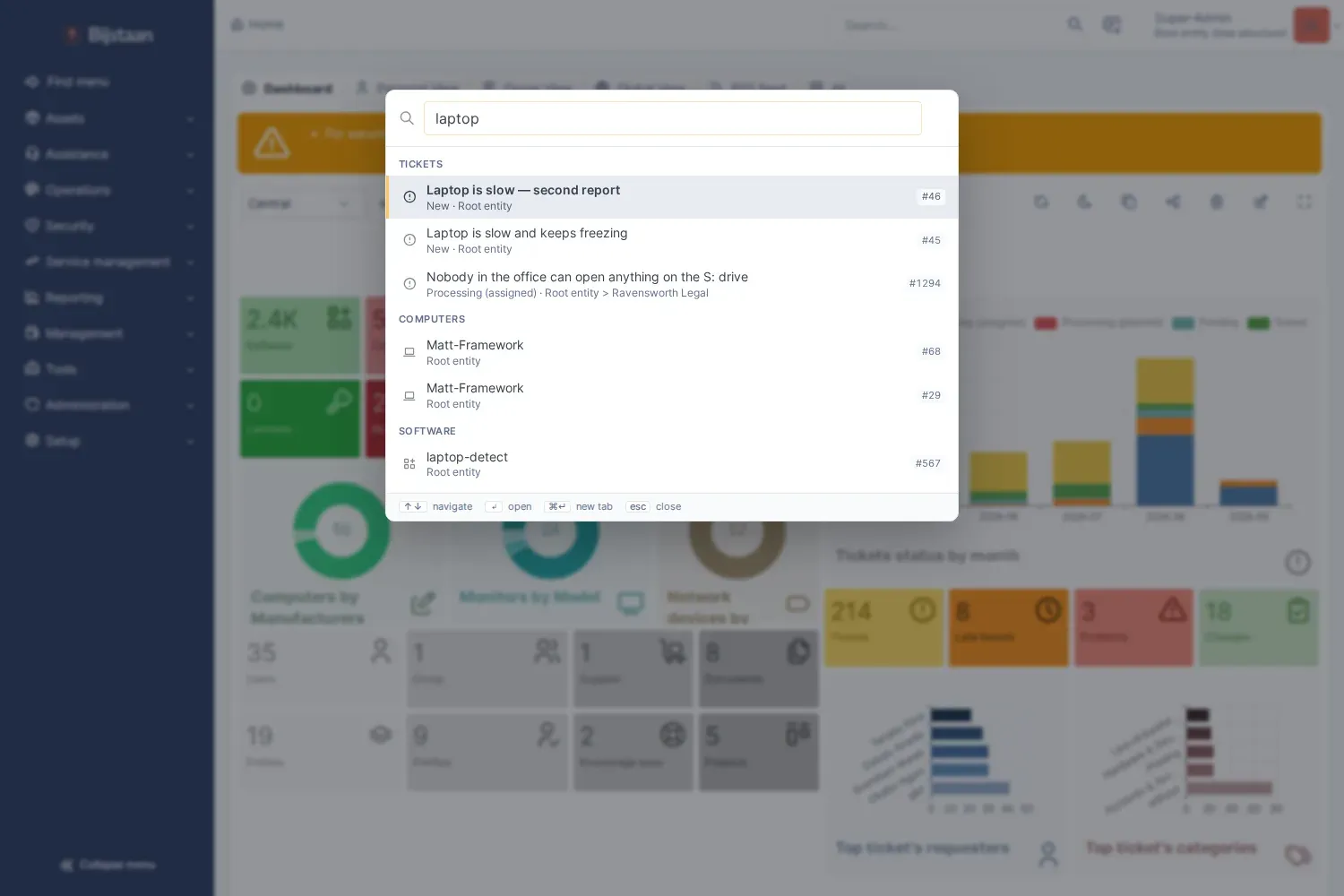
Compared to core’s Find menu
Section titled “Compared to core’s Find menu”GLPI 11 ships a fuzzy finder on Ctrl+Alt+G. It is a menu finder —
Html::getMenuFuzzySearchList() returns navigation entries, so it reaches the
ticket list but not a ticket. This plugin searches records as well and folds the
menu in as one result group. It does not touch core’s binding; the two coexist.
| Find menu (core) | Command palette | |
|---|---|---|
| Shortcut | Ctrl+Alt+G | Ctrl/Cmd+K (configurable) |
| Menu destinations | ✔ | ✔ |
| Records (tickets, assets, users…) | ✘ | ✔ via global search |
| Type scoping | ✘ | computer: dell |
| Jump by id | ✘ | #4821 |
| Recents | ✘ | ✔ (browser-local) |
| Input | Does |
|---|---|
laptop |
Searches records and commands |
>ticket |
Commands and menu only |
computer: dell |
Records of one type only |
#4821 |
Direct jump to that ticket |
↑ ↓ |
Move selection |
↵ |
Open |
⌘↵ / Ctrl+↵ |
Open in a new tab |
esc |
Close |
Type scoping accepts any of GLPI’s 30 globalsearch_types. The six searched by
default are what runs without being asked, not a ceiling.
Optional: faster record search
Section titled “Optional: faster record search”Records are matched with GLPI’s contains, which matches by whole word — type
priner and nothing comes back.
With the glpisearch plugin installed and indexing, record results come from
there instead: typo-tolerant, matching from the first character, answering in
single-digit milliseconds. Types it is not indexing still go through GLPI’s own
search, as does everything if Meilisearch is unreachable.
The switch is under Setup → Plugins → Command palette and reports the other
plugin’s actual state. src/FastSearch.php is the only file naming it, every
reference is a string rather than an import, and every call is guarded.
Install
Section titled “Install”# from the GLPI root — the directory must be named for the plugin key,# which is not the repository namegit clone https://github.com/bijstaan/glpi-palette.git plugins/glpipalettephp bin/console plugin:install -u glpi glpipalettephp bin/console plugin:activate glpipaletteSettings
Section titled “Settings”Setup → Plugins → Command Palette.
| Setting | Default |
|---|---|
| Searched by default | Ticket, Change, Problem, Computer, User, Software |
| Results per itemtype | 5 |
| Minimum characters | 2 |
| Bind Ctrl/Cmd+K | on |
Bind / |
off |
The default type list is short because records go through Search::getDatas()
with a view contains criterion — the same path as the header search box, which
inherits entity restrictions and profile rights rather than hand-rolling LIKE
queries that could return rows the user may not see.
The cost is one query per itemtype across every displayed column. A sweep of all 30 configured types measured ~140ms on a near-empty dev database, and a palette runs a query per keystroke. Hence six types, a two-character floor before records are searched, a 180ms debounce and abort-on-retype.
How it works
Section titled “How it works”Ctrl+K │ ├─ bootstrap (once per page, prefetched when idle) │ commands + menu entries ──► matched in the browser, instant │ └─ search (per keystroke, debounced 180ms, abortable) Finder ──► Search::getDatas() ──► grouped recordsCommands and menu destinations are a bounded per-session list, fetched once and ranked client-side, so the palette responds to the first keystroke. Only records need the server.
Ranking is tiered: exact title → prefix → word-start → substring → subsequence. Without the tiers a subsequence hit in a long menu path can outrank an exact match.
Security notes
Section titled “Security notes”- Scopes are bounded by
globalsearch_types. The scope name arrives from the browser and is used as a class name; unbounded, that turns a search box into a way to probe tables the interface never exposes.Configis a real class and is correctly rejected. #idjumps resolve server-side throughcanViewItem(), so the palette cannot confirm which ids exist to someone with no rights to them.- Titles render with
textContent. GLPI’s search rows carry adisplaynamefield of pre-rendered HTML including an inline<script>qtip initialiser; the plugin reads the raw name column and never hands markup to the DOM. - CSRF rides the
X-Glpi-Csrf-Tokenheader, which GLPI 11’s kernel validates and preserves. In the POST body it would consume a token per keystroke and drain the session pool. - Nothing is recorded server-side. No tables. Recents live in
localStorage.
cd tests/browser && node palette-check.jsCovers opening, record search, > command mode, type scoping (asserting the
scoped result set is narrower than the unscoped one), #id jumps, arrow
navigation, Enter-to-open, recents and Escape.
Limitations
Section titled “Limitations”- Navigation only. Every command opens something; none submit, assign, close or delete. Mutating actions want a confirmation step designed for them first.
- No server-side or cross-device recents, by design.
- No fuzzy matching for records without
glpisearch— those use GLPI’scontainssemantics, solptopwill not find “Laptop”. Commands and menu entries are fuzzy either way.
Licence
Section titled “Licence”GPL-3.0-or-later, the same licence as GLPI. The plugin is loaded into GLPI’s process and extends its classes, so it is a derivative work. See LICENSE.